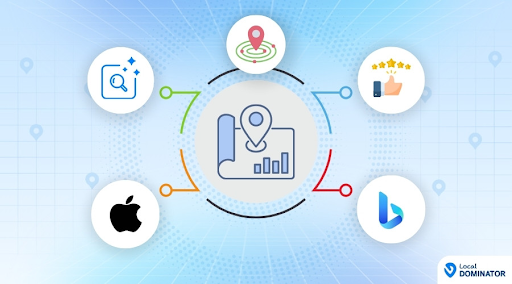
If you’ve ever searched your business on Google Maps from two different spots and got two different results, you’re not imagining it. Local search rankings do not behave like traditional blue link SEO. They change based on where the searcher is and how strong your business looks in that exact area.
This guide explains what actually shapes local rankings and how to turn those Local Search Ranking Factors into a clear, repeatable audit process using a Local SEO Audit Tool to reveal what is holding a business back.
Why Local Rankings Change from Street to Street
Google tries to show the best business for the person searching in that exact moment. Because of this, results change depending on the physical location of the searcher, even when nothing about the business itself has changed.
Three forces drive this behavior.
- Proximity measures how close the business is to the searcher.
- Relevance measures how closely the business matches what was searched.
- Prominence measures how trusted and authoritative the business looks compared to nearby competitors.
Because proximity changes block by block, the only way to understand true local visibility is to look across many points in a service area rather than relying on a single city center view.
What Google Uses to Rank Local Results
Local rankings are not based on one magic signal. They come from a stack of small signals that add up over time. The fastest way to improve results is to focus on the signals Google can verify easily and consistently.
Categories and Services
Your primary category is one of the strongest relevance signals on your profile. If it’s too broad or slightly off, you can end up showing for the wrong searches or losing to businesses that match the query more closely.
Services strengthen category signals by telling Google exactly what you offer. They also help you appear for longer and more specific searches that usually convert better.
In a proper audit, categories and services are not reviewed in isolation. They are compared against the businesses that dominate the same neighborhoods for the same search. If competitors use different categories where they win, that reveals a relevance gap.
Profile Completeness and Trust
A complete Google Business Profile makes it easier for Google to trust what you do and where you do it. Hours, phone number, address, service area, attributes, and photos all support this.
Consistency matters more than people expect. If your profile, website, and listings disagree, Google has to guess, and that uncertainty can reduce visibility.
Reviews and Reputation
Reviews show that real customers are choosing your business. They also influence future customers, which feeds back into performance.
What matters most is not just your star rating. It is how frequently you receive reviews and how that pace compares to the competitors appearing above you. A steady and believable review pattern almost always performs better than a sudden spike.
In competitive markets, comparing your review growth against nearby competitors is one of the fastest ways to find a prominence gap.
Citations and NAP Consistency
Citations are mentions of your business name, address, and phone number across directories and apps. When the details match, it supports trust and reduces confusion.
Old addresses, outdated phone numbers, duplicate listings, and inconsistent naming all reduce prominence. Some of the most damaging problems come from GPS and voice search platforms that still hold incorrect data even when Google looks correct.
Website Signals That Support Maps
Your website still plays an important role in local rankings. Clear service pages and location pages help Google understand what you offer and where you serve.
Internal linking also matters. If your most important services or locations are difficult to find, your relevance can appear weaker than it actually is.
When proximity is similar between two businesses, Google often uses website relevance and topical authority as the deciding factor.
A Practical Local SEO Audit Workflow
A good audit does not try to analyze everything at once. It focuses on one service and one area, then expands from there.
Step 1. Choose a keyword and service area
Pick the exact phrase a customer would search, such as emergency plumber in downtown Phoenix. This keeps the audit focused and actionable.
Step 2. Run a grid-based ranking scan
Check rankings from many points across the service area. This reveals where proximity helps and where prominence fails. Single location rank tracking hides these patterns.
Step 3. Separate Google Maps from the Local Pack
Maps prioritize proximity. The Local Pack prioritizes prominence. A business can look strong in Maps but be nearly invisible in the Local Pack, where customers actually choose.
Step 4. Compare competitors across the grid
Overlay the top competitors for the same keyword and area. Look for patterns in categories, reviews, and profile strength where they win and lose.
Step 5. Verify trust signals
Scan citations, duplicates, and NAP consistency across the web. Any mismatch creates a ranking ceiling, no matter how strong the rest of the profile appears.
Step 6. Evaluate page relevance
Compare your service and location pages to the competitors that dominate the grid. Missing services, weak internal links, or thin content often explain why prominence is lagging.
Turning Your Notes Into a Short Plan
After the audit, organize your findings into two groups.
Trust blockers
These are issues that prevent Google from trusting your business data. They include incorrect profile details, category mismatches, duplicate listings, and inconsistent citations.
Prominence gaps
These explain why competitors outrank you in specific neighborhoods. They usually involve weaker reviews, incomplete services, or pages that do not clearly support the search.
Fix trust blockers first. Then focus on improving the signals that build relevance and prominence.
Tools That Help You Stay Consistent
Manual audits work for a single location. They become difficult to manage when you are dealing with multiple locations or highly competitive markets. Grid tracking, competitor comparisons, citation checks, and reporting must live inside one workflow for this to scale.
This is where Local Dominator fits naturally. It is a cloud-based Search Everywhere Platform specializing in unified local SEO and AI search tracking for local agencies and businesses. It serves as a single source of truth by integrating SERP analytics and citation data, making visibility simple, predictable, and scalable across all digital touchpoints.
Final Thoughts
Local rankings change block by block. Businesses that grow are the ones that measure what is happening across their real service area and fix the issues that hold them back.
When Local Search Ranking Factors are connected to a structured audit process, and a Local SEO Audit Tool is used to track performance, you stop guessing and start seeing exactly where your next wins will come from.