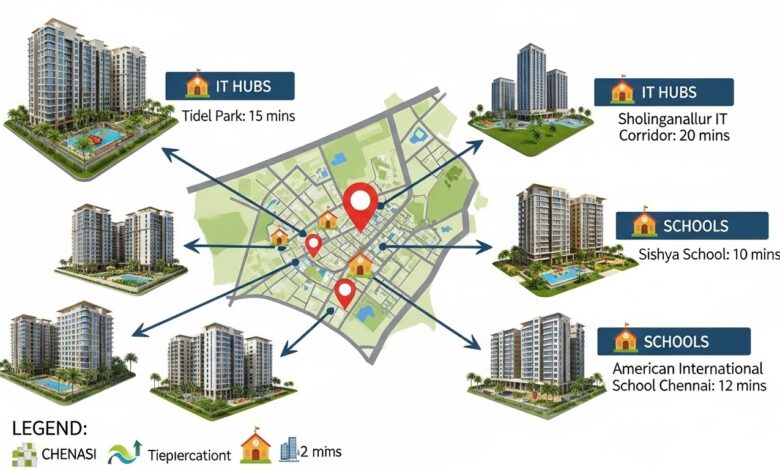
Residential location has become a strategic decision for families and professionals in Chennai. The city now hosts one of India’s most concentrated clusters of technology parks, along with a wide network of international and CBSE-affiliated schools. As a result, daily travel time, access to public transport, and proximity to employment centers have emerged as primary factors in housing selection. This article examines how specific residential corridors provide superior access to both information technology hubs and educational institutions, allowing homebuyers to evaluate Chennai apartments through a practical, infrastructure-driven lens.
The Role of Connectivity in Residential Value
Connectivity directly influences productivity, family schedules, and long-term property appreciation. According to data from the Chennai Metropolitan Development Authority, more than 60 percent of new commercial office supply over the last decade has been concentrated along the Old Mahabalipuram Road, GST Road, and the western IT corridor. At the same time, over 45 percent of Chennai’s top-rated private schools operate within a 10-kilometer radius of these zones.
This spatial relationship has increased demand for Chennai apartments located along major arterial roads, Metro corridors, and suburban railway lines. Reduced commute durations lower transportation expenses and improve work-life balance, while school access reduces dependency on private transport for children.
Old Mahabalipuram Road (OMR): The Technology Spine
Old Mahabalipuram Road remains Chennai’s primary technology corridor. Stretching from Thiruvanmiyur to Siruseri, OMR hosts technology parks such as TIDEL Park, RMZ Millenia, SIPCOT IT Park, and Ascendas. According to Tamil Nadu’s IT Department, this corridor supports more than 500,000 technology professionals.
Residential clusters in Perungudi, Thoraipakkam, Sholinganallur, and Navalur have grown alongside this expansion. These areas also contain established schools such as Gateway International School, Hiranandani Upscale School, and Sree Sankara Global Academy. Apartments in this zone offer proximity to offices as well as structured academic environments, which reduces daily travel pressure on working parents.
Metro Phase II, currently under development, is expected to connect Madhavaram to SIPCOT, further strengthening OMR’s long-term transport outlook.
Velachery and Pallikaranai: Balanced Urban Access
Velachery and Pallikaranai form a critical link between the city center and OMR. Velachery railway station connects directly to Chennai Beach, providing rapid access to central business districts. The Velachery–Tambaram Main Road also links residents to the GST Road corridor.
Schools such as DAV Public School, Velammal New Gen School, and Zion International operate within short commuting distance. For professionals working in Guindy, Taramani, or OMR, Apartments in Velachery and Pallikaranai offer a practical middle ground that supports both employment access and educational continuity.
Porur and the Western IT Corridor
Porur has developed into a major residential and commercial node following the expansion of the DLF IT Park and L&T Infotech campuses in nearby Manapakkam. The Chennai Metro Blue Line connects Porur Road to Alandur, from where travelers access both the airport and central business districts.
Educational institutions such as Omega International School, PSBB Millennium, and Lalaji Memorial Omega International School are located within this corridor. Porur and its surrounding micro-markets, including Mogappair and Ramapuram, attract professionals from Guindy, Ambattur, and the Sriperumbudur industrial belt. Apartments in this zone benefit from radial road connectivity and expanding Metro coverage.
Tambaram and GST Road: Southern Transit Advantage
GST Road functions as the southern gateway to Chennai, connecting the city to the Mahindra World City SEZ and the Oragadam industrial area. Tambaram railway station serves as one of the busiest suburban hubs in South India, with direct lines to Chennai Beach and Chengalpattu.
Prominent schools such as Shree Niketan, Alpha International, and Holy Sai International operate in this corridor. Apartments in Tambaram, Selaiyur, and Perungalathur support a lifestyle that combines industrial employment access with dependable suburban rail transport.
Infrastructure and Future Outlook
Metro Phase II, suburban rail modernization, and the Peripheral Ring Road project are reshaping Chennai’s urban geography. According to the Chennai Unified Metropolitan Transport Authority, these investments are projected to reduce peak-hour road travel times by 25 to 30 percent across key residential corridors over the next decade.
These developments reinforce the importance of selecting Chennai apartments in zones aligned with transit-oriented development. Areas already linked to IT clusters and school districts will continue to benefit from improved travel efficiency and commercial investment.
Conclusion
Connectivity to technology parks and schools represents a defining criterion for residential decision-making in Chennai. Corridors such as OMR, Velachery, Porur, and Tambaram offer integrated access to employment, education, and transport infrastructure. Chennai apartments located within these zones provide measurable advantages in daily convenience and long-term property performance.
For families and professionals evaluating housing options, an infrastructure-focused approach offers a reliable method for identifying neighborhoods that support both career objectives and academic stability. As Chennai’s transport network continues to expand, the relationship between residential location and connectivity will remain a central driver of urban value.