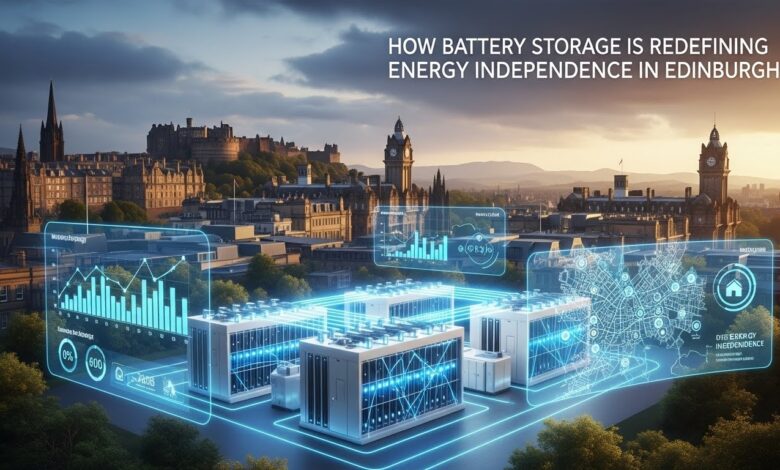
Edinburgh homeowners and businesses are discovering that solar panels alone no longer represent the pinnacle of energy independence, as battery storage technology fundamentally transforms how the city consumes and manages electricity.
The Scottish capital’s unique position, with its unpredictable weather patterns and progressive climate goals, makes battery storage particularly valuable for maximising renewable energy benefits.
As energy costs continue to challenge household budgets and grid reliability faces increasing pressures, battery systems have emerged as the critical missing piece in Edinburgh’s journey towards true energy autonomy.
Edinburgh’s Energy Landscape and Storage Imperative
The capital’s specific geographical and climatic conditions create distinct challenges and opportunities that make battery storage systems particularly advantageous for local residents.
With Edinburgh’s characteristic cloud cover, variable daylight hours, and ambitious net zero commitments, Renew-Able Solutions helps property owners understand why battery storage has become essential rather than optional for maximising renewable energy investments.
The convergence of Scotland’s renewable energy targets, local grid constraints, and fluctuating electricity prices has positioned battery technology as a transformative solution for Edinburgh households and businesses.
Edinburgh-specific factors driving battery storage adoption:
- Scotland’s renewable energy mix creates grid instability that battery systems help mitigate at household level
- Edinburgh’s limited winter daylight hours necessitate energy storage for evening and morning consumption peaks
- Local grid infrastructure in older Edinburgh neighbourhoods struggles with bidirectional energy flows from solar exports
- Scottish Government incentives and targets for energy independence align with battery storage capabilities
- Historic building regulations in Edinburgh city centre require discrete, efficient energy solutions
- Rising connection charges from Scottish Power make energy independence increasingly attractive financially
- Community energy initiatives across Edinburgh neighbourhoods benefit significantly from coordinated battery deployment
Transforming Solar Investment Returns
Battery storage systems fundamentally alter the economics of solar panel installations by capturing and maximising the value of every kilowatt-hour generated.
Edinburgh’s solar panels produce surplus electricity during daylight hours when household demand remains relatively low, with traditional systems exporting this valuable energy to the grid for minimal compensation.
Modern battery solutions retain this self-generated power for use during expensive evening peak periods, dramatically improving return on investment.
1. Maximising Self-Consumption Rates
Without battery storage, typical Edinburgh households consume only 30% to 40% of their solar-generated electricity, exporting the remainder at rates far below retail prices.
Quality battery storage increases self-consumption to 70% to 90%, effectively quadrupling the financial benefit of solar panels.
This transformation means homeowners use their own clean energy when it matters most, during expensive evening hours when grid electricity costs peak.
2. Eliminating Peak Rate Electricity Purchases
Edinburgh households with battery systems avoid purchasing electricity during expensive peak periods between 4pm and 8pm when rates can exceed 30p per kilowatt-hour. Instead, stored solar energy powers evening cooking, heating, lighting, and entertainment without touching grid electricity or incurring standing charges.
Over a year, this peak-time avoidance saves typical Edinburgh families £400 to £700 beyond standard solar savings.
3. Enhanced Smart Export Guarantee Returns
Battery systems allow strategic timing of grid exports, selling electricity back when rates are highest rather than accepting whatever price applies when the sun shines.
Some Scottish energy suppliers offer time-of-use export tariffs paying premium rates during peak demand periods, with battery owners earning 15p to 25p per kilowatt-hour.
This intelligent export strategy can double the income generated from surplus solar production compared to standard export arrangements.
4. Protection Against Time-of-Use Tariffs
As Scottish energy suppliers increasingly implement time-of-use pricing structures, battery storage provides protection against expensive peak-period rates that penalise evening consumption.
Edinburgh households can charge batteries during off-peak hours when electricity costs as little as 7p per kilowatt-hour, then use this stored energy during peak times.
This arbitrage opportunity becomes increasingly valuable as the gap between peak and off-peak rates widens.
5. Faster Solar System Payback Periods
Battery storage reduces typical solar panel payback periods in Edinburgh from 10 to 12 years down to 7 to 9 years by maximising self-consumption and export revenues.
The combined system delivers greater total savings despite the additional upfront investment in battery technology.
Edinburgh homeowners report that battery-enhanced solar systems often pay for themselves before the manufacturer’s warranty expires.
6. Long-Term Value Appreciation
As grid electricity prices continue rising and battery technology improves, the value of existing battery storage systems appreciates rather than depreciates like most home appliances.
Edinburgh properties with installed battery systems command premium prices, with estate agents reporting 6% to 12% increases in property valuations.
This investment appreciation makes battery storage one of the few home improvements that genuinely increases net worth.
Resilience and Energy Security Benefits
Beyond financial advantages, battery storage provides Edinburgh residents with unprecedented control over their energy supply and protection against increasingly common grid disruptions.
Scotland’s ambitious renewable energy transition occasionally creates grid stability challenges, whilst aging infrastructure in historic Edinburgh neighbourhoods proves vulnerable to weather-related outages.
Battery systems transform homes into resilient micro-grids capable of maintaining power during disruptions.
1. Backup Power During Outages
Edinburgh experiences periodic power cuts during severe weather events, with some neighbourhoods losing electricity for hours or occasionally days during winter storms.
Battery storage systems with backup capability automatically provide emergency power to essential circuits, keeping refrigerators, heating controls, lighting, and communication devices operational.
This resilience proves particularly valuable for vulnerable residents, home-based businesses, and families with medical equipment dependencies.
2. Grid Independence During Peak Demand
During cold Edinburgh winters when grid demand peaks and electricity costs soar, battery storage allows complete disconnection from the National Grid for hours at a time.
This independence eliminates exposure to potential brownouts or voltage fluctuations that damage sensitive electronics and appliances.
Edinburgh households report greater peace of mind knowing their energy supply remains stable regardless of grid conditions.
3. Protection Against Future Grid Constraints
As Edinburgh’s electricity demand grows through heat pump and electric vehicle adoption, local grid infrastructure faces increasing strain requiring expensive upgrades.
Battery storage reduces individual household peak demand, decreasing pressure on neighbourhood transformers and distribution networks.
This reduced grid dependency becomes increasingly valuable as connection charges and capacity limitations affect new developments across Edinburgh.
4. Energy Autonomy for Historic Properties
Edinburgh’s extensive conservation areas and listed buildings face restrictions on external modifications that complicate renewable energy installations.
Battery systems provide discrete indoor solutions that maximise limited solar capacity by storing every available kilowatt-hour.
This technology enables historic property owners to achieve meaningful energy independence whilst respecting architectural heritage requirements.
5. Community Microgrid Potential
Forward-thinking Edinburgh neighbourhoods are exploring community battery schemes where multiple households coordinate storage systems to create resilient local microgrids.
These collaborative approaches provide collective backup power, shared export revenues, and enhanced grid services that benefit entire streets.
Pilot projects in areas like Corstorphine and Portobello demonstrate how coordinated battery deployment strengthens community energy resilience.
6. Weather-Related Vulnerability Reduction
Edinburgh’s exposed coastal location and hilly terrain create localised weather patterns that occasionally disrupt power supplies to specific neighbourhoods.
Battery storage insulates households from these geographical vulnerabilities by maintaining electricity supply during localised outages.
Residents in exposed areas like Cramond, Leith, and the Pentland Hills foothills particularly value this weather-independent energy security.
Smart Technology Integration and Future-Proofing
Modern battery storage systems function as sophisticated energy management platforms that integrate seamlessly with emerging smart home technologies and evolving grid services.
These capabilities position Edinburgh households at the forefront of the UK’s energy transition whilst providing pathways for continuous system improvement and expansion.
Investment in battery storage today unlocks benefits that will compound over decades as technology and energy markets evolve.
Advanced battery system capabilities:
- Artificial intelligence learns household consumption patterns and optimises charge and discharge cycles automatically
- Weather forecasting integration adjusts storage strategies based on predicted solar generation and temperature changes
- Electric vehicle charging coordination ensures both car and home batteries optimise electricity costs and carbon reduction
- Virtual power plant participation allows Edinburgh batteries to provide grid services and earn additional revenues
- Modular expansion enables capacity increases as family needs grow or electric vehicle adoption increases energy requirements
- Remote monitoring and diagnostics detect potential issues before they affect performance or require emergency repairs
- Integration with Scottish Water smart meters and district heating systems creates comprehensive home energy ecosystems
Battery Storage System Comparison
| System Capacity | Installation Cost | Daily Storage | Backup Duration | Lifespan | Annual Savings |
| 5kWh | £4,000 – £5,500 | Powers evening use | 3-4 hours | 10-15 years | £300 – £500 |
| 10kWh | £7,000 – £9,500 | Full day coverage | 8-10 hours | 10-15 years | £600 – £900 |
| 15kWh | £10,000 – £13,000 | Multi-day storage | 12-16 hours | 10-15 years | £900 – £1,300 |
Conclusion
Battery storage technology has fundamentally redefined what energy independence means for Edinburgh residents, transforming solar panels from daytime electricity generators into comprehensive energy management systems.
The unique combination of Edinburgh’s climate, grid infrastructure, progressive energy policies, and rising electricity costs creates ideal conditions for battery storage to deliver exceptional financial and resilience benefits.